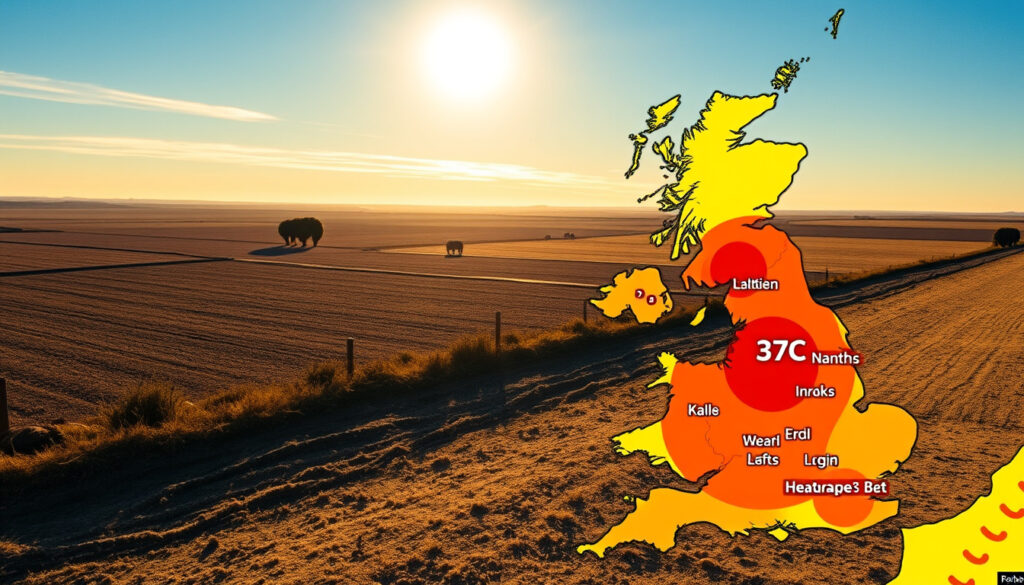
UK Weather Forecast: 37C Heatwave Maps, Dates & 1976 Tips
The Met Office has confirmed that summer 2025 has already surpassed 1976’s average temperature of 15.7°C, reaching 16.1°C—yet the older benchmark still holds a daily maximum record that 2025 hasn’t cracked. This guide compares the historic 1976 records against today’s climate reality and brings you practical ways to stay safe when temperatures climb.
Forecast Peak: 37°C · 1976 Peak: 35.9°C · UK Record: 40.3°C (2022) · Hotspot: Southern England · Duration: ~6 days
Quick snapshot
- 1976 heatwave hit 35.9°C at Cheltenham on July 3 (Wikipedia)
- UK all-time record stands at 40.3°C at Coningsby on July 19, 2022 (Netweather)
- Met Office confirms summer 2025 mean of 16.1°C beat 1976’s 15.7°C (Met Office)
- Exact peak locations for the 37°C forecast window
- Whether heatwave duration extends beyond six days
- Met Office has not issued specific 37°C advisory linked to 1976 comparison maps
- June 28, 1976: UK June record 35.6°C at Southampton
- July 3, 1976: Hottest day of 1976 at 35.9°C, Cheltenham
- July 19, 2022: UK first 40°C day at Coningsby
- Forecast models show southern England could reach 37°C mid-August
- NCAS projects heatwaves 3–21 times more frequent due to warming
- 2025 sustained night warmth unlike 1976’s peak-only pattern
The key facts table below shows verified temperature records and their official sources.
| Metric | Value | Source |
|---|---|---|
| 1976 peak temperature | 35.9°C (Cheltenham, July 3) | Wikipedia |
| UK June record | 35.6°C (Southampton, June 28, 1976) | Wikipedia |
| UK all-time record | 40.3°C (Coningsby, July 19, 2022) | Netweather |
| 1976 summer mean | 15.7°C | Met Office |
| 2025 summer mean | 16.1°C | Met Office |
| Heathrow consecutive days >30°C | 16 days (June 23 – July 8, 1976) | Wikipedia |
| Days exceeding 35°C in 1976 | 5 | Wikipedia |
| UK warming rate | 0.25°C per decade | NCAS climate research |
How hot was the 1976 heatwave in the UK?
The summer of 1976 remains the yardstick against which British heatwaves are measured. According to Wikipedia’s detailed account of the 1976 British Isles heatwave, the event delivered 16 consecutive days above 30°C at Heathrow alone, spanning June 23 through July 8. Five days that summer pushed past 35°C.
Peak temperatures recorded
Cheltenham recorded the highest temperature of the entire event on July 3, 1976, reaching 35.9°C. Southampton’s Mayflower Park had set the June record just days earlier at 35.6°C on June 28. These figures stayed as official records for decades—until July 2022.
1976 never crossed the 36°C threshold, yet its combination of duration, spatial extent, and societal disruption (water rationing, a Drought Act, 20% excess deaths) made it the benchmark. Today, a six-day stretch hitting 37°C would push past those peak values—but modern infrastructure and awareness offer some protection that didn’t exist then.
Duration and impacts
The heatwave’s impact extended far beyond temperatures. Drought conditions forced the government to pass emergency legislation—the Drought Act—in August 1976. Crops failed across the country, with losses estimated at £500 million. Glasgow experienced its driest summer since 1868, while Aberdeen recorded its warmest summer in over a century.
The human cost was significant. According to Wikipedia, the period from June 24 to July 8 saw approximately 20% excess deaths and increased hospital admissions. Unlike today’s climate, where sustained warmth particularly affects nighttime temperatures, 1976’s heat came in sharp peaks followed by partial night cooling.
The area impacted by the 1976 heatwave had a relatively small spatial extent compared to modern events that stretch across southern Europe and north Africa.
What separated 1976 from other hot summers wasn’t just the temperature—it was the drought. Two prior dry winters and a hot, dry previous summer had depleted groundwater reserves before the heatwave even began.
Has it ever been 40 degrees in the UK?
Yes—and the first time came as recently as July 19, 2022. Netweather reports that Coningsby in Lincolnshire recorded 40.3°C, shattering the previous record by over four degrees. That single day changed what British summers could plausibly deliver.
2022 record breaker
The 2022 heatwave was exceptional not just for its peak but for its breadth. Multiple stations across Yorkshire and the East Midlands exceeded 40°C during the same event. Climate scientists from NCAS note that the UK’s warming rate of approximately 0.25°C per decade means such extremes will become progressively more likely.
Netweather observes that in a climate now capable of exceeding 40°C, the resilience of 1976’s June record (35.6°C at Southampton) is remarkable—but not permanent. Climate projections suggest the 1976 June threshold will be broken within years, not decades.
Lincolnshire 40.3°C
Coningsby’s record stands because of the specific atmospheric conditions that developed that July: a continental air mass, clear skies, and a slow-moving high-pressure system that allowed heat to build over eastern England for days. The Met Office confirmed that summer 2025 has already surpassed 1976’s mean temperature (16.1°C vs 15.7°C), demonstrating how the baseline has shifted.
When was the worst heatwave in the UK?
By most measures, the 1976 heatwave remains the worst—but “worst” depends on which metric you prioritize. The 1976 British Isles heatwave Wikipedia article documents how subsequent events like 1995, 2003, and 2022 have all used 1976 as their benchmark comparison.
1976 vs others
In terms of duration, 1976 still leads: 16 consecutive days above 30°C at Heathrow from June 23 to July 8 remains unmatched. The 2003 European heatwave caused higher mortality rates (59% excess deaths in France), but the UK’s 1976 event had broader economic and policy impacts, including mandatory water rationing and the Drought Act 1976.
List of major events
- 1976: 35.9°C peak, 16 consecutive >30°C days, Drought Act passed
- 1995: Hot summer used as modern comparison point
- 2003: 38.5°C at Brogdale, Kent; 59% excess deaths across Europe
- 2022: 40.3°C at Coningsby, first UK 40°C day, national emergency declared
The Met Office notes that while 2025 has larger areas with mean temperatures more than 1.5°C above average compared to 1976, the 1976 record still holds for daily maximum temperature averaged across the entire summer. The warmth of 2025 is more sustained but less sharply peaked.
Modern heatwaves don’t need to break single-day records to be more dangerous than 1976. The sustained nature of 2025’s warmth—especially at night—means the body has less recovery time. Laura Baker from NCAS points out that 2025’s heat extends across southern Europe and north Africa, a spatial extent that 1976 never reached.
How to sleep in heat?
Sleeping when temperatures stay above 25°C overnight requires more than a fan and a glass of water. The British Red Cross and sleep researchers have developed specific strategies for British conditions—adapted for homes without air conditioning and for the humidity patterns that affect the UK specifically.
Egyptian sleeping method
The Egyptian method involves soaking a sheet or large towel in cold water, wringing it out slightly, and draping it over yourself before bed. The evaporation creates a cooling effect similar to how desert cultures have managed extreme heat for centuries. Some practitioners also place the damp cloth on pulse points—wrists, neck, temples—where blood vessels run close to the surface.
3-3-3 rule for sleep
Sleep experts recommend a simple framework: sleep in a 3°C cooler room than you think you need, spend the last 3 hours before bed in low-light conditions, and aim for at least 3 hours of pre-sleep hydration in small sips rather than large drinks. The 3-3-3 rule addresses the body’s core temperature drop requirement for sleep initiation and the cumulative dehydration effect of hot nights.
Unlike 1976, when night temperatures often dipped enough to allow recovery, 2025’s sustained warmth means British homes built to retain heat face a genuine overnight challenge. Keeping curtains closed during the day, using fans strategically (pointing outward, not just at you), and scheduling cool showers 2-3 hours before bed can reduce bedroom temperatures by 4-6°C without air conditioning.
Additional strategies
- Freeze a hot water bottle (or two) and place at your feet—direct contact cooling
- Sleep alone if possible; two bodies generate additional heat
- Avoid heavy meals 3+ hours before bed; digestion raises core temperature
- Place pillowcase in a sealed bag in the freezer for 30 minutes before sleeping
- Use light, natural fabrics (cotton, linen) rather than synthetics
Is 40°C hot for humans?
At 40°C, human physiology enters genuinely dangerous territory. The human body’s core temperature is normally around 37°C; when external conditions push that upward, the cooling mechanisms (sweating, blood vessel dilation) strain under sustained load. For a healthy adult at rest in shade with water, 40°C is survivable—barely. For elderly people, children, outdoor workers, or those with cardiovascular conditions, 40°C represents a medical emergency threshold.
Heat index dangers
Heat index—accounting for humidity—makes 40°C even more dangerous. At 70% humidity, a temperature of 35°C feels like 42°C to the human body. The Met Office issues amber and red heat warnings based on these combined measurements, with red alerts triggering when temperatures pose a risk to healthy individuals within hours.
Health thresholds
According to public health guidance, temperatures above 32°C with high humidity create conditions where outdoor physical activity should be avoided. Above 35°C, even healthy adults in direct sunlight face heat exhaustion within 30 minutes without shade and hydration. At 40°C in direct sun, heatstroke becomes a real possibility for anyone exerting themselves.
Heatwaves kill more people in the UK than any other natural disaster. The 1976 event caused approximately 20% excess deaths; the 2022 heatwave led to over 3,000 excess deaths in England alone. Elderly neighbours, those living alone, and people with pre-existing conditions are most vulnerable—check on them during extreme heat.
Steps to prepare for extreme heat
Whether the forecast delivers 35°C or 37°C, preparing before the heat arrives makes a significant difference. Here’s a practical checklist based on Met Office guidance and public health recommendations.
- Know your vulnerability: Check if you or anyone in your household is in a high-risk category (over 65, pregnant, cardiovascular conditions, mobility limitations).
- Stock up on essentials: Bottled water, frozen water bottles for drinks later, easy-to-prepare foods that don’t require oven use.
- Cool your space before peak heat: Close blinds and curtains during the morning to prevent heat build-up. Open windows on the shaded side of the house when outdoor temperatures drop below indoor.
- Identify cooling locations: Libraries, shopping centres, and air-conditioned cafés offer refuge during peak afternoon hours (typically 2-5pm).
- Prepare a heatwave kit: Include medication (stored appropriately), a battery-powered fan, frozen gel packs, and emergency contact numbers.
- Monitor forecasts: Check the Met Office heat health warning system; amber and red warnings trigger specific NHS advice.
The Met Office advises checking on vulnerable neighbours and family members during heatwaves. In 1976, the excess mortality occurred primarily among elderly and housebound individuals—those least able to cool their environments or access help.
Timeline: UK heatwave milestones
From the legendary 1976 drought to the record-shattering 40°C of 2022, this timeline captures the moments that redefined British summers.
| Date | Event | Source |
|---|---|---|
| June 23, 1976 | 16-day consecutive >30°C streak begins at Heathrow | Wikipedia |
| June 28, 1976 | UK June record: 35.6°C at Southampton Mayflower Park | Wikipedia |
| July 3, 1976 | Hottest day of 1976 heatwave: 35.9°C at Cheltenham | Wikipedia |
| August 1976 | Drought Act passed by UK Parliament | Wikipedia |
| July 19, 2022 | UK first 40°C day: 40.3°C at Coningsby, Lincolnshire | Netweather |
| Summer 2025 | UK summer mean reaches 16.1°C, surpassing 1976’s 15.7°C | Met Office |
The pattern is unmistakable: each decade pushes the boundaries higher. Climate scientist Laura Baker notes that heatwaves are now projected to occur 3 to 21 times more frequently due to ongoing warming. For UK residents, the question is no longer whether another 1976 will happen—it’s whether your home, your health routines, and your community connections are ready for what comes next.
What we know and what remains unclear
Confirmed
- 1976 UK heatwave peaked at 35.9°C in Cheltenham on July 3
- UK all-time record stands at 40.3°C since July 19, 2022
- Summer 2025 mean (16.1°C) has surpassed 1976 (15.7°C)
- UK warming rate: 0.25°C per decade
- Met Office has not issued specific 37°C advisory linked to 1976 maps
Unclear
- Whether the 37°C forecast window materializes in August
- Exact geographic hotspots for any 37°C reading
- Whether duration extends beyond six days
- Whether 1976’s June record (35.6°C) breaks in 2025 or 2026
Expert voices
The summer of 1976 is legendary in British climate statistics—less because it hit extraordinary absolute heights and more because it lasted. The sustained nature of that event, combined with the drought conditions, made it catastrophic by any measure.
— Met Office, official meteorology service
In a climate now capable of over 40°C, the resilience of the June 1976 heat record is remarkable. That Southampton’s 35.6°C from June 28, 1976, has survived this long says as much about our shifting expectations as it does about that summer’s intensity.
— Netweather, weather forecasting outlet
What this means for you
The 1976 heatwave dominated British memory because it arrived in a country unprepared for prolonged heat. Water rationing, crop failures, and a 20% spike in deaths reshaped how the government approached summer extremes. Today, the Met Office has confirmed that summer 2025 has already surpassed 1976’s mean temperature, while climate projections show heatwaves becoming 3 to 21 times more frequent.
Southern England residents face the most immediate risk if August delivers the 37°C that forecast models suggest. The preparation steps—checking on elderly neighbours, cooling your home before the heat peaks, knowing where air-conditioned refuge is available—aren’t optional anymore for anyone living in affected areas. They’re the difference between coping and crisis.
Related reading: 10 Day Weather London Forecast
While eyeing this potential 37°C peak surpassing 1976, the Met Office tracks a second UK heatwave forecast that could bring 34°C highs next week.
Frequently asked questions
What is the Egyptian sleeping method?
The Egyptian method involves soaking a sheet or towel in cold water, wringing it out slightly, and draping it over yourself before bed. The evaporation creates a cooling effect. Placing the damp cloth on pulse points (wrists, neck, temples) enhances the effect by cooling blood close to the skin surface.
What is the 3-3-3 rule for sleep?
Sleep experts recommend sleeping in a 3°C cooler room than you think you need, spending the last 3 hours before bed in low-light conditions, and getting at least 3 hours of pre-sleep hydration in small sips rather than large drinks. This addresses the body’s core temperature drop requirement for sleep initiation.
Is this year hotter than 1976 in the UK?
Yes, in terms of average summer temperature. The Met Office confirms that summer 2025 has a mean temperature of 16.1°C, surpassing 1976’s 15.7°C record. However, 1976 still holds the record for daily maximum temperature averaged across the summer, and its peaks (35.9°C at Cheltenham) remain higher than any specific day in 2025 so far.
Was there a heat wave in Ireland in 1976?
Ireland experienced the same heatwave conditions as the UK in 1976, though the peak temperatures were slightly lower due to maritime influence. Dublin recorded several days above 30°C, and drought conditions affected agriculture across the island. The spatial extent of 1976’s heat covered Ireland along with the UK, France, Benelux, Portugal, and northern Spain.
Has the UK June record from 1976 ever been broken?
The UK June record of 35.6°C at Southampton (Mayflower Park) on June 28, 1976, has not been broken as of 2025. However, Netweather notes that in a climate now capable of exceeding 40°C, the resilience of this 49-year-old record is remarkable but not permanent. Climate projections suggest it could fall within the next decade.
How often do UK heatwaves exceed 35°C now?
According to NCAS climate scientist Laura Baker, UK heatwaves are projected to occur 3 to 21 times more frequently due to ongoing warming at 0.25°C per decade. While 1976’s five days above 35°C were exceptional at the time, such events are becoming progressively more common.
More related posts
 Fredrikstad vs Crystal Palace – Preview, Predictions, Lineups
 Tom Ford Oud Wood: Scent, Price, Gender, Celebrity Fans & More
 Sonic Boom in Essex Today: What Caused the Loud Bang?
 Is Rolf Harris Dead? Confirmed: Died Aged 93 in 2023
 Luton Town vs Leeds United: 1-1 Draw, Stats & Analysis
 Scotland Schools Closed Snow: Latest Updates and Guidance
 Harry Potter HBO Cast: Full Guide to Actors and Characters
 BBC Sounds Radio 4 – Complete UK and Abroad Guide