Can You Put Tin Foil in an Air Fryer? Safety Guide
If you’ve ever scraped burnt cheese off an air fryer basket, you already know the frustration of scrubbing baked-on grease. Using aluminum foil could prevent that mess — but some manufacturers say no, and the rules vary enough that a single answer doesn’t cover everyone. This guide cuts through the confusion with official brand positions, airflow science, and safer alternatives so you can decide what’s right for your kitchen.
Safe to use foil: Yes, if not touching heating element (Midea Canada) · Foil melting risk: No, won’t melt at air fryer temps · Key rule: Weight foil down to prevent flying · Airflow impact: Avoid covering all basket holes
Quick snapshot
- Foil is safe if placed flat, weighted, and away from heating element (Midea Canada)
- KitchenAid and Whirlpool countertop models explicitly prohibit foil (KitchenAid, Whirlpool)
- Exact rules vary by model — always check your manual
- Ninja SP101 prohibits foil on trays or racks specifically
- Brand policies clarified over recent years as air fryer ownership grew
- Most manufacturers now publish explicit guidance online
- Parchment paper remains the safer default for most users
- Silicone liners offer a reusable middle ground
These comparisons show how foil and parchment differ across the features that matter most for air fryer performance.
| Claim | Detail |
|---|---|
| Foil compatibility | Most models yes |
| Primary risk | Airflow blockage |
| Health safe | Yes at standard cooking temps |
| Ninja specific | Generally safe if secured, but tray/rack prohibited |
Can you put aluminum foil into an air fryer?
The short answer from most manufacturers: yes, with conditions. Midea Canada states that foil is safe to use in an air fryer “so long as you use it the right way,” specifically keeping it flat in the basket and away from the heating element at the top. However, several brands draw harder lines. KitchenAid explicitly prohibits foil in its countertop air fryers, and Whirlpool makes the same call for countertop models while allowing foil in ranges with air fry settings.
Safety rules for using foil
- Place foil flat on the basket bottom — never draped loosely
- Ensure foil does not touch the heating element or walls
- Weight the foil with food or a light object to prevent it from lifting
- Leave gaps around the edges for airflow
- Check your model’s manual before using foil
The main hazard isn’t melting — aluminum foil has a far higher melting point than an air fryer reaches. The real risk is airflow obstruction. When foil blocks the basket holes, hot air can’t circulate properly, leading to uneven cooking and potential grease buildup that could cause a fire. Light foods like lettuce-wrapped fish can also lift loose foil toward the heating element, creating a contact risk.
Common mistakes to avoid
- Covering the entire basket with foil — this blocks circulation entirely
- Using foil with acidic foods like tomatoes or lemon, which can leach metal and impart a metallic taste
- Placing foil on the tray or rack (especially prohibited on Ninja Foodi SP101 models)
- Preheating with foil already inside
Even when your model allows foil, using it reduces the crispiness of foods like chicken wings compared to direct basket cooking. If that golden crunch is what you’re after, a bare basket outperforms foil every time.
“Never put foil on the tray or rack. Laying aluminum foil directly on the oven tray or wire rack blocks air flow and traps grease, and that can cause a fire.”
— Ninja Foodi SP101 Guide
“Personally, I recommend parchment paper as a safer and more effective alternative. It lets air circulate more freely, giving you an even browning and crisp texture all over.”
— Viktor Velikov, Director of Elserve, interviewed by Woman & Home
For most air fryer owners, foil is permissible in some models and prohibited in others, and the brand-specific rules matter more than any universal permission.
Upsides
- Catches drippings for easy cleanup
- Wraps foods evenly for packet-style cooking
- Works for acidic foods if food is wrapped, not foil-only contact
Downsides
- Blocks airflow if not positioned carefully
- Reduces crispiness in breaded foods
- Banned outright by several major brands
Is it better to use parchment paper or foil in an air fryer?
For most home cooks, parchment paper wins on safety and performance. Velikov recommends parchment as a safer and more effective alternative, noting it lets air circulate more freely for even browning and crisp texture. Parchment is also non-reactive, so it won’t interact with acidic foods the way foil sometimes can.
Parchment vs foil pros and cons
The following breakdown compares these two liners across the features that most affect cooking results and safety.
| Feature | Parchment paper | Aluminum foil |
|---|---|---|
| Heat resistance | Safe up to 450°F ( Courtney’s Sweets) | Safe at all air fryer temps |
| Airflow | Perforated versions allow circulation | Risk of blocking if not positioned |
| Reactivity | Non-reactive with acids | Can react with acidic foods |
| Cleanup | Single-use | Reusable if not torn |
| Crispiness impact | Slight reduction vs bare basket | Moderate reduction vs bare basket |
When to choose each
Choose parchment when you want even airflow, non-stick coverage, and don’t mind buying rolls regularly. Choose foil when you’re wrapping foods for packet cooking, need to contain liquids, or are lining under a roast to catch drippings. Just never use wax paper — it isn’t heat-safe and will melt or catch fire in an air fryer.
Parchment paper locks in flavor and moisture, but it absorbs oil differently than a bare basket, which can soften breading. If you want maximum crunch, neither liner compares to cooking directly on the basket surface.
The pattern shows parchment as the safer default while foil suits specific tasks like drip catching or packet cooking.
Is it unhealthy to use aluminum foil in an air fryer?
At standard air fryer cooking temperatures, aluminum foil is non-toxic and poses no known health risk when used correctly. Midea Canada confirms that foil in an air fryer is safe from a toxicity standpoint, with the main caveat being acidic foods. Research on aluminum exposure from cooking is mixed, but the consensus among manufacturers and food safety bodies is that normal use at cooking heat doesn’t present a concern.
Health concerns with foil
- Aluminum can leach into food when used with acidic ingredients like tomatoes, citrus, or vinegar
- The leached amount is considered minimal and unlikely to cause acute effects
- Those with specific health conditions restricting aluminum intake should consult guidelines
Safe usage tips
- Avoid placing foil directly under acidic foods — use parchment between food and foil if both are needed
- Don’t reuse crumpled or torn foil that may have degraded
- Use foil primarily as a liner, not as direct food contact for tomato-based or citrus-marinated dishes
The implication is that most healthy adults face negligible risk, but acidic cooking scenarios warrant extra caution.
Can I wrap chicken in foil in an air fryer?
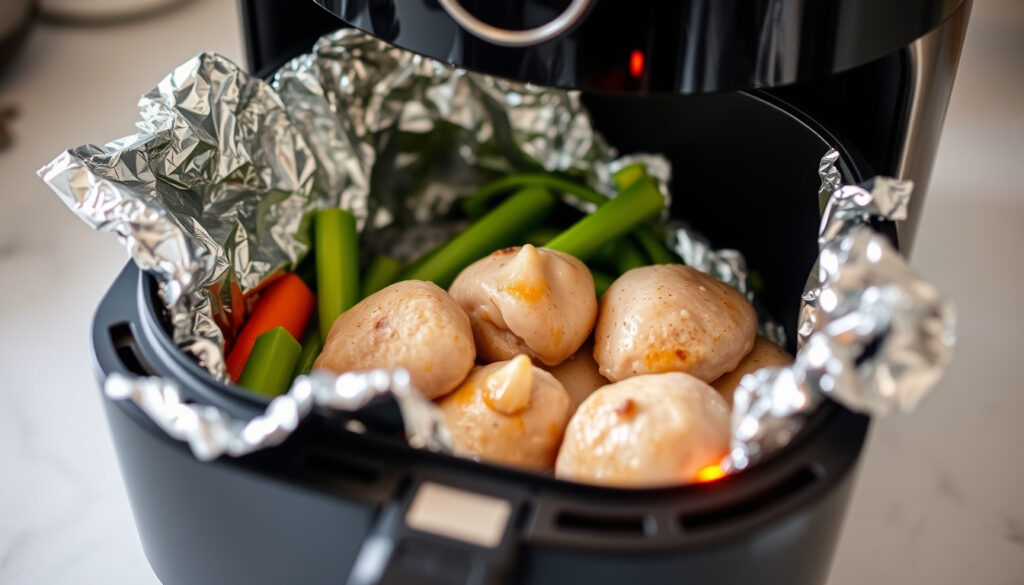
Yes, you can wrap chicken in foil for an air fryer — and it works well for certain cuts. Chicken breasts benefit from foil packet cooking because the enclosed environment traps steam, keeping the meat juicy while the air fryer finishes the outside. The key is securing the packet so it doesn’t shift or unfold during cooking. Fish wrapped in foil also works if the wrap is tight and the piece is lightweight enough not to push foil toward the heating element.
Foil packet recipes
- Chicken breasts: seal with a little oil and herbs, cook at 375°F for 15-20 minutes depending on thickness
- Salmon fillets: fold foil around the fish with a lemon slice and butter, cook at 400°F for 8-10 minutes
- Vegetable packets: toss chopped veggies in oil, seal in foil pouch, cook at 380°F for 12-15 minutes
Fish and pie wrapping tips
For fish, a loose but secure fold works best — leave one opening end to let steam escape. For foil-wrapped pies in an air fryer, ensure the pie dish fits the basket dimensions and that no foil overhangs the edges. If your air fryer basket has a non-stick coating, skip direct foil contact with the coating itself and use a parchment layer underneath the dish instead.
The implication for home cooks is that foil packets suit moist cooking styles but demand careful securing to prevent airflow hazards.
What should you not put in an air fryer?
Beyond foil considerations, certain items genuinely don’t belong in an air fryer. Wet batter foods like fried chicken batters or tempura don’t crisp well because the high-speed air dries the outside before the inside cooks. Items that block airflow entirely — including dense layers of foil, a full parchment sheet without holes, or oversized dishes — cause uneven results and potential safety issues.
Foods and items to avoid
- Wet batter dishes that need deep frying
- Large cuts of meat that need longer, slower cooking
- Leafy greens that blow around and may contact the heating element
- Popcorn — not a typo, this has caused fires in closed appliances
- Frozen pizza or cheese that melts and drips through non-perforated liners
What can ruin your air fryer
- Using abrasive scrubbers on non-stick coatings
- Submerging the appliance in water — wipe clean only
- Blocking the airflow with oversized accessories
- Running the air fryer empty for extended periods
- Ignoring model-specific prohibitions in the manual
What this means is that the appliance rewards light use and punishes misuse — airflow is the engine, and anything that strangles it shortens the machine’s life.
Related reading: Stainless Steel Pan Set · Best Pressure Washer UK
Frequently asked questions
Can you put tin foil in an air fryer Ninja?
Ninja air fryers generally permit foil in the basket if placed flat and secured, but the Ninja Foodi SP101 explicitly prohibits foil on the tray, rack, or crumb tray. Always check your specific model’s manual.
Why can’t you use tin foil in an air fryer?
Some brands prohibit foil because it can block airflow, leading to uneven cooking and grease accumulation that poses a fire risk. Loose foil can also lift toward the heating element during cooking.
Can you put a pie in tin foil in an air fryer?
Yes, if the pie dish fits the basket without covering all the holes and no foil overhangs the edges. Use a parchment layer under the dish if your basket has non-stick coating.
Can I wrap fish in foil in an air fryer?
Yes, fish can be wrapped in foil in an air fryer. Keep the wrap tight and secure, and ensure the foil doesn’t press against the heating element or fan.
What can ruin an air fryer?
Abrasive cleaning tools, submerging in water, blocking airflow with oversized accessories, and running the appliance empty for long periods can damage an air fryer or create safety hazards.
Can I fry an egg in an air fryer?
Yes, but use a small ramekin or silicone cup to prevent the egg from spreading. Crack the egg into the container, add to the preheated basket, and cook at 320-350°F for 3-5 minutes.
Can you put aluminum foil in an oven?
Yes, with similar precautions as an air fryer: keep foil away from heating elements, don’t cover the entire oven floor, and never line the bottom of a gas oven where it can block the flame sensor.
Can you put aluminum foil in a microwave?
No — microwaves cause arcing on metal surfaces and can damage the appliance or create a fire hazard. Never put foil in a microwave.
More related posts
 Troye Sivan: Health, Relationships, and Career Facts
 5 11 in cm: Exact Conversion, Comparisons and Height Facts
 Karaoke Songs Album Songs – Top Tracks from Hit Albums
 Jeff Daniels: Career, Movies, Friendship with Jim Carrey & More
 Jon Batiste’s Health Condition, Wife, Children, and More
 Ricky Martin: Biography, Net Worth, Wife, Kids, and Latest News
 Salmon Oil for Dogs – Benefits, Dosage and Safety
 Liverpool vs Leicester City – Trent Goal Seals Relegation