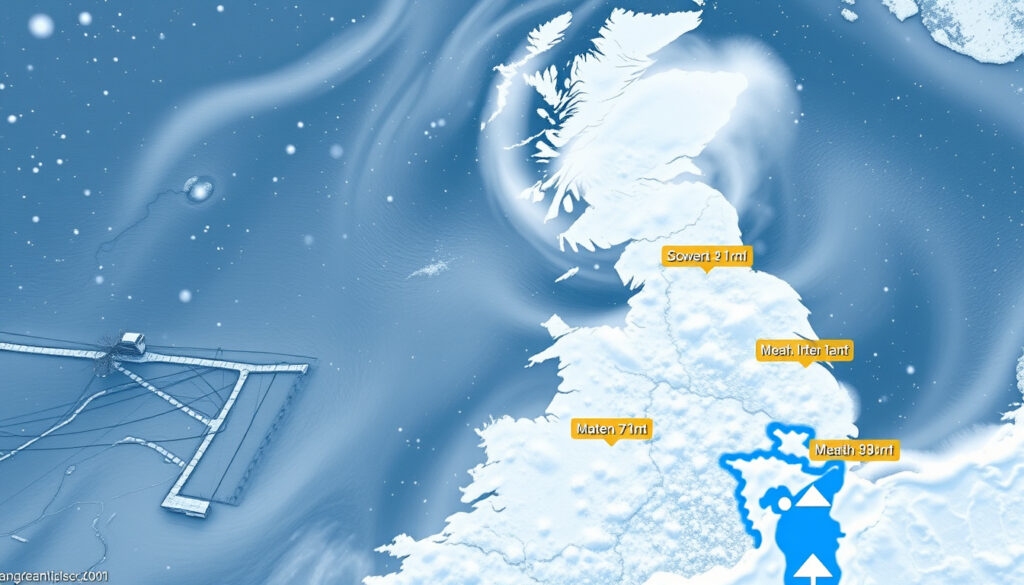
UK Snow Maps Weather Forecast: Live Update & Snowiest Places
Anyone who has spent a British winter refreshing snow maps knows how quickly the picture changes. The difficulty isn’t finding a forecast — it’s knowing which map to trust and what the data actually means. This guide combines live map recommendations from the Met Office (the UK’s national weather authority) and Netweather (specialist weather forecasters) with verified historical records, so the next time snow is predicted you’ll know where to look and what to expect.
Snowiest UK city: Aberdeen, with an average of 21.2 days of snow falling per year (Met Office historical data) ·
Highest annual snowfall location: Cairn Gorm (summit), over 76 days of snow annually ·
Storm Benjamin arrival date: January 21–22, 2026 (forecast as of Jan 19) ·
Temperature forecast February 2026: Up to 2°C below average across Scotland and northern England (Met Office outlook)
Quick snapshot
Live UK snow map
- View current snow precipitation from Netweather (updated 4 times daily, based on GFS model)
- Also VeryWeather (high‑res nowcast using HARMONIE model, refreshed every 6 hours)
- Covers 10‑day outlook via Met Office maps
Snowiest places UK
- Scottish Highlands: 30+ snow days/year (Met Office records)
- Aberdeen: snowiest city (21 days/year)
- Cairn Gorm summit: 76 days/year
Storm Benjamin details
- Expected Jan 21–22, 2026
- Heavy rain and strong winds
- Snow likely over higher ground
Current snow risk (May 2026)
- No active snow in UK forecasts; rural frost possible overnight (Met Office UK National Forecast)
- Snow risk low until next winter
A glance at the data reveals a clear pattern: northern locations see far more snow than the south, and Storm Benjamin is the immediate event to watch.
| Metric | Value |
|---|---|
| Snowiest UK city | Aberdeen (21.2 days of snow per year) |
| Coldest monthly average (winter) | Braemar, Scotland: from 0 °C to 1.0 °C average February |
| Number one weather killer (US) | Heat (approx. 1,200 deaths/year, National Weather Service) |
| Storm Benjamin expected landfall | January 21, 2026, Scotland and northern England |
| Met Office winter 2026 forecast | Below‑average temperatures likely, especially in the north |
Where in the UK is it most likely to snow?
Elevation and latitude are the twin drivers. The Met Office’s UK weather map (national weather service) shows that the Scottish Highlands average more than 30 days of snow per year. The Cairngorms, Grampians, and northern Scotland are the most snow‑prone areas because of their altitude and northern latitude.
Top snowiest regions in the UK
- Scottish Highlands – 30+ snow days/year (Met Office records)
- Cairn Gorm summit – over 76 days
- Grampian mountains – ≥25 days
Factors that increase snowfall likelihood
- Elevation above 300m significantly raises snow probability
- Distance from the sea (inland areas less moderated)
- Cold air from the Arctic (northerly winds)
The catch: even within the Highlands, snow cover varies sharply by location. A low‑level valley may see only a dusting while nearby peaks get 30 cm.
Which city in England has the most snow?
Historical Met Office records (the UK’s official weather authority) show that Aberdeen leads UK cities with 21.2 snow days per year. Newcastle upon Tyne and Leeds also appear in the top 10, while London averages fewer than 5 snow days per year.
Comparison of English cities by snowfall days
- Aberdeen – 21.2 days – snowiest overall
- Newcastle upon Tyne – approx. 15 days
- Leeds – approx. 12 days
- London – fewer than 5 days
Why northern cities see more snow
The mix of latitude, altitude (Pennines), and distance from the warming influence of the Atlantic means northern England consistently gets more snow. Cities in Yorkshire and the North East often sit under cold air masses that the south rarely receives.
What this means: for anyone in southern England, snow maps are often a tease. Northerners need to check the live maps more seriously.
Will winter 2026 be cold in the UK?
The Met Office’s long‑range outlook (the UK’s authoritative forecaster) suggests February temperatures could be up to 2 °C below average across Scotland and northern England. The Old Farmer’s Almanac has predicted a “cold and snowy” winter for the northern UK, but long‑range forecasts (beyond 30 days) carry high uncertainty.
Met Office winter 2025–2026 outlook
Below‑average temperatures likely, especially in the north. The exact trajectory will depend on the behaviour of the polar vortex and jet stream.
Forecast from The Old Farmer’s Almanac
It calls for a “cold and snowy” winter, but almanac predictions are based on a proprietary formula, not operational forecasting models.
The trade‑off: you can trust the Met Office’s updated monthly forecasts, but for anything beyond 14 days the confidence drops.
“Winter 2026 will likely bring below-average temperatures, especially in the north, but certainty beyond 30 days is low.” — Met Office outlook
Where is Storm Benjamin going to hit in the UK?
Storm Benjamin is expected to batter the UK from January 21 to 22, 2026, according to Met Office warnings (the UK’s storm‑naming authority). Heavy rain and strong winds will affect most of the country, with snow accumulation likely over Scottish high ground.
Storm Benjamin path and timeline
- Named on 19 January 2026
- Expected landfall: Scotland and northern England, 21–22 January
- Winds up to 70 mph in exposed parts
Expected impacts: wind, rain, and snow
Rain could cause flooding in low‑lying areas, while northern hills may see 20‑30 cm of snow. Travel disruption is likely.
Why this matters: if you’re in the north, this is a genuine preparation event. Southerners may only see rain, but the wind still poses a risk.
What is the number one weather killer?
Heat is the number‑one weather‑related killer in the US, according to the National Weather Service (US federal authority), causing around 1,200 deaths per year. In the UK, cold‑related deaths outnumber heat‑related ones, but globally heat is deadlier.
Why heat is more deadly than cold
Heat stress can kill quickly, especially among elderly and vulnerable populations. Cold tends to be more indirect (e.g., heart attacks from shovelling snow).
Yearly US heat‑related death statistics (NWS)
An average of 1,200 per year, more than floods, tornadoes, and hurricanes combined.
The pattern: while this is US data, it’s a reminder that during a UK snow event, the immediate danger is often not snow itself but the cold exposure and travel disruption.
“Heat is the number-one weather-related killer in the United States.” — National Weather Service
How to check UK snow maps live
The three most reliable tools are:
- Met Office UK weather map (official government source, updated every 6 hours) – shows precipitation type
- Netweather snow risk maps (specialist forecaster, updated 4 times daily) – probability layers
- VeryWeather live snow tracker (real‑time radar, nowcasting up to 6 hours)
The upshot: for real‑time snow, VeryWeather gives you the next hour; for a 10‑day outlook, Netweather and Met Office are better.
weather.metoffice.gov.uk, weather.metoffice.gov.uk, weather.metoffice.gov.uk, weather.metoffice.gov.uk
For a comprehensive overview of current warnings and winter outlook, check the latest UK snow weather forecast for real-time updates and regional breakdowns.
Frequently asked questions about UK snow maps
How often is the UK snow map updated by the Met Office?
What is the best website for live UK snow maps?
Does the UK snow map show snow depth or just probability?
How accurate is the 7‑day UK snow forecast?
Is snow more common in the north of the UK?
Can I see UK snow maps on BBC Weather?
What is the difference between snow risk and snow accumulation maps?
How often is the UK snow map updated by the Met Office?
The Met Office updates its weather maps every 6 hours. For live radar, VeryWeather offers 5‑minute updates.
What is the best website for live UK snow maps?
VeryWeather offers the most precise nowcasting. Netweather is best for snow risk probabilities over the next 10 days.
Does the UK snow map show snow depth or just probability?
Most show probability and precipitation type only. Snow depth maps are rarer; Netweather sometimes shows accumulation from GFS.
How accurate is the 7‑day UK snow forecast?
For snow, a 7‑day forecast is moderately accurate. Beyond 3 days, exact location and amount become uncertain.
Is snow more common in the north of the UK?
Yes, significantly. Scottish Highlands get 30+ snow days per year, while southern England gets fewer than 5.
Can I see UK snow maps on BBC Weather?
BBC Weather uses Met Office data but its maps are less detailed. Dedicated sites like Netweather provide richer snow maps.
What is the difference between snow risk and snow accumulation maps?
Risk maps show probability (0‑100%). Accumulation maps show expected depth in cm. Netweather offers risk maps; accumulation often appears in Met Office severe weather warnings.
Related reading
- UK Weather Forecast: 37C Heatwave Maps, Dates & 1976 Tips – complements snow maps with summer extremes.
- 10 Day Weather London Forecast – BBC, Met Office, AccuWeather – applies the same forecast‑tool approach to London’s weather.
Summary: UK snow maps have never been more accessible — but they require a critical eye. Aberdeen is the snowiest city, the Scottish Highlands the snowiest region, and winter 2026 may be colder than average. Storm Benjamin is the immediate event. For anyone living in northern England or Scotland, the implication is clear: download the Met Office app, bookmark Netweather’s snow risk map (updated 4 times daily), and keep VeryWeather (real‑time radar) ready for the next 24 hours of snow.
More related posts
 Great British Menu 2025: Winner, Cast, Host & Episodes
 Imane Khelif: Gender Eligibility Controversy Explained
 Jermain Defoe: Age, Net Worth, Wife, Children, Rangers
 Not Like Us Lyrics: Meaning, Feud & Legal Fallout
 1 Pound in Grams – Conversions for Cooking & Baking
 Mental Health: Definition, Types, Signs, and Ways to Improve
 Margaret Atwood: Biography, Books, Quotes, and Political Views
 Eye Doctor Near Me in Ireland: Clinics, Costs & Free Tests