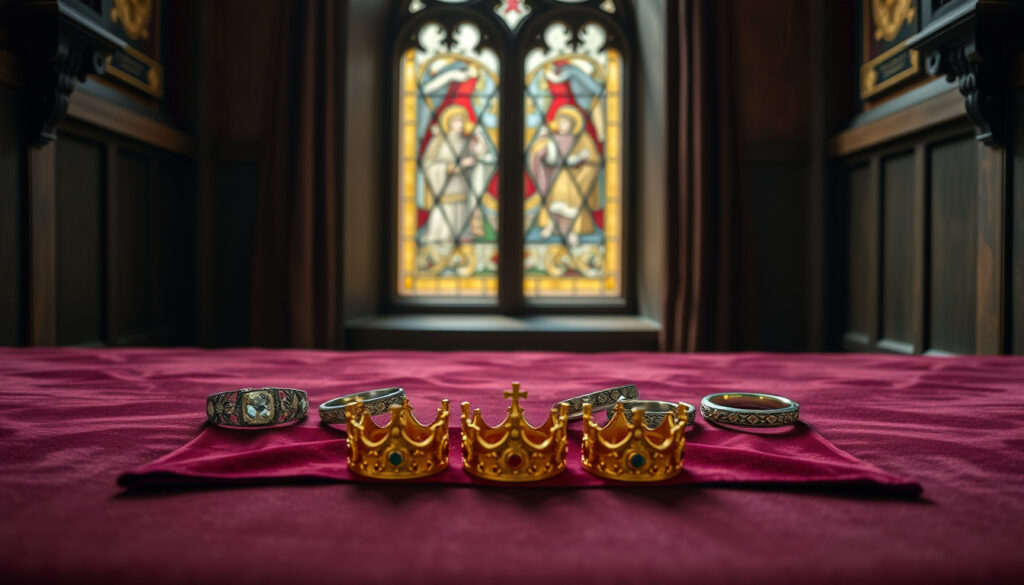
Henry VIII: Six Wives, Three Children, and the Church of England
Henry VIII’s six marriages were not scandals—they were instruments of statecraft that reshaped England’s religion and place in Europe. He married six times between 1509 and 1543 (Britannica’s royal biography), and every one of those marriages shifted the politics of Europe — and ultimately the religion of England.
Wives: 6 ·
Reign duration: 38 years (1509–1547) ·
Children recognized as legitimate: 3 ·
Executed wives: 2 ·
Birth date: 28 June 1491
Quick snapshot
- Six marriages between 1509 and 1543 (Britannica’s royal biography).
- Three legitimate children survived: Mary, Elizabeth, and Edward (Historic Royal Palaces).
- All three children ruled England in turn (Historic Royal Palaces, the charity that manages Hampton Court Palace).
- The exact number of illegitimate children Henry fathered is not documented.
- How far Henry personally drove Anne Boleyn’s conviction is debated.
- Living descendants of the Boleyn family are hard to trace with certainty.
- 1509 — Henry took the throne (Britannica).
- 1533 — the break with Rome opened the way to Anne Boleyn (World History Encyclopedia).
- 1547 — Henry died, leaving the crown to Edward VI (Historic Royal Palaces).
- Edward VI, Mary I, and Elizabeth I each reigned in turn (Historic Royal Palaces).
- The Tudor dynasty ended with Elizabeth I’s death in 1603 (the official royal family history).
- Hampton Court Palace survives as a major visitor site (Historic Royal Palaces).
Henry VIII at a glance
Six measurements, one pattern: Henry’s entire public life was a single, unbroken 38-year arc, and every key date lands inside it.
| Label | Detail |
|---|---|
| Born | 28 June 1491, Greenwich Palace |
| Died | 28 January 1547, Whitehall Palace |
| Reign | 22 April 1509 – 28 January 1547 |
| Father | Henry VII, King of England |
| Mother | Elizabeth of York |
| Coronation | 24 June 1509 |
The pattern: born in 1491, crowned in 1509, dead by 1547 — the entire English Reformation fits inside that span.
What is King Henry VIII most famous for?
Henry VIII ruled England from 1509 to 1547 (Britannica’s Henry VIII biography), and in those 38 years he changed the country’s religion, its succession, and its standing in Europe. The short version of his fame: six marriages, one break with Rome, and three children who each later wore the crown (Historic Royal Palaces, the charity that runs Hampton Court Palace).
The break with Rome and the Church of England
- The Church of England was established because Rome refused to annul Henry’s first marriage (Britannica’s royal biography).
- The move made Henry, not the pope, the head of England’s church (the official royal family history).
The trigger was dynastic. Catherine of Aragon had given Henry one surviving child, a daughter, Mary, and no living son. When the pope would not untie the marriage, Henry untied the whole English church from Rome. The consequences were enormous: the monasteries were dissolved, religious life was reordered, and the crown gained powers it never gave back.
For a monarch who saw himself as the equal of any king in Europe, the break was as much about authority as about the annulment itself.
Henry did not plan the English Reformation as a movement — he needed a divorce, and the Reformation was the price. That is why the English church kept so much of its Catholic ritual even after the break.
The six marriages and their political context
- In order: Catherine of Aragon, Anne Boleyn, Jane Seymour, Anne of Cleves, Catherine Howard, Catherine Parr (Royal Museums Greenwich, the UK’s national maritime museum).
- Two of the six wives were executed; two were cast off; one died; one survived.
Each marriage was a diplomatic instrument. A queen consort brought an alliance, a religion, and the promise of heirs — or the threat of neither. Henry’s negotiators treated marriage contracts like treaties, because that is exactly what they were. The wives who worked as alliances survived; the ones who became liabilities did not.
That pattern is the key to the whole reign: Henry’s marital strategy was a security policy, and its failures produced wars, executions, and a new national church.
Patronage, palaces, and the royal image
- Hampton Court Palace was one of Henry VIII’s largest building projects and is now managed by Historic Royal Palaces (the charity that cares for it today).
- Henry built and expanded palaces as visible statements of royal power.
The palaces were not just homes; they were instruments of state. Henry’s rebuilding program, at Hampton Court and beyond, kept the court moving through spaces designed to impress diplomats and overawe courtiers — the same instinct for display that ran through his marriages.
What happened to the six wives of Henry VIII?
The old mnemonic — divorced, beheaded, died, divorced, beheaded, survived — is a fair summary of the six outcomes, but the reasons matter more than the rhyme (Royal Museums Greenwich’s royal history pages).
Divorced, beheaded, died, divorced, beheaded, survived
- Catherine of Aragon — marriage annulled in 1533, according to Wikipedia’s chronology of Henry’s wives.
- Anne Boleyn — marriage ended in 1536; she was executed.
- Jane Seymour — died in 1537 after giving birth to the future Edward VI.
- Anne of Cleves — marriage lasted only months in 1540.
- Catherine Howard — executed in 1542 after the marriage collapsed.
- Catherine Parr — survived Henry; the marriage produced no children (the official royal family history).
Two details make the list more than trivia. First, the only wife who “died” — Jane Seymour — was also the only one to give Henry the son he wanted. Second, the “survived” wife, Catherine Parr, was the one who outlived him, not the one he loved most. The mnemonic describes outcomes, not affection.
Catherine of Aragon and the fight for a divorce
Henry broke with Rome to make a new marriage possible — and the marriage he fought for so hard lasted barely three years before ending in execution.
Catherine of Aragon was Henry’s first wife and the mother of the future Mary I. She was also, from Henry’s point of view, the obstacle: the marriage had produced only one surviving child, a daughter, and no male heir. Her failure to produce a son, combined with her refusal to step aside, pushed Henry toward a solution no English king had tried before — declaring himself supreme head of the Church of England.
Anne Boleyn and the fall from favor
- Anne Boleyn became Henry’s second wife and the mother of Elizabeth I (Historic Royal Palaces).
- She was executed in 1536 on charges of treason (World History Encyclopedia).
Anne’s story is where the personal and the political collide most sharply. She was the wife who triggered the break with Rome and the first queen consort to be executed in England. Some historians argue she was guilty of little more than being a queen without a son; others point to her role in court factions. The record is clear on the outcome and much less clear on how far Henry personally directed the case.
What this means: a wife was safe while she advanced the succession or an alliance, and in danger the moment she did not. That logic, not simple cruelty, explains the sequence of the six marriages.
How many bastards did Henry VIII have?
The honest answer: one son was publicly acknowledged, and the full count is unknowable.
Henry FitzRoy: the acknowledged son
- Henry FitzRoy was publicly recognized as Henry VIII’s son (Royal Museums Greenwich’s royal history pages).
- He was created Duke of Richmond and Somerset.
FitzRoy’s mother was Elizabeth Blount, a lady-in-waiting. His father’s recognition was a public statement that Henry could and would acknowledge a son born outside marriage. FitzRoy was given titles and precedence that placed him above almost everyone except the legitimate royal children. His rise showed how badly Henry wanted a male heir — and how willing he was to use an illegitimate son to make the point.
Other possible children
Henry recognized exactly one illegitimate son, but recognition is a political act, not a biological census. The real number of his children outside marriage cannot be counted from the surviving record.
The exact number of illegitimate children Henry fathered is not documented. Later genealogies have suggested other names, but the evidence is thin, and no other child was ever acknowledged. What is certain is that the official count stops at one.
The legitimate heirs who mattered
- Three legitimate children survived to adulthood: Mary, Elizabeth, and Edward.
- All three later ruled England in turn.
The contrast is sharp: the one illegitimate son Henry promoted was never crowned, while the three legitimate children he acknowledged all became monarchs. Edward was born in 1537 to Jane Seymour, Mary in 1516 to Catherine of Aragon, and Elizabeth in 1533 to Anne Boleyn. Each child carried a different mother’s religion and political baggage.
The irony: the king who tore England apart for a son ended up with a son whose reign lasted six years, and two daughters whose reigns lasted nearly half a century combined.
Is Queen Elizabeth related to King Henry VIII?
Yes — but which Queen Elizabeth you mean matters. Elizabeth I was Henry’s own daughter; Queen Elizabeth II was related to him through the wider Tudor family, not through his bloodline.
Elizabeth I: daughter and last Tudor
- Elizabeth I was born in 1533 to Henry VIII and Anne Boleyn.
- She was the last Tudor monarch, reigning from 1558 to 1603.
Elizabeth was the second daughter Henry had in place of the son he wanted — and she turned out to be the most successful of his children. She ruled for 45 years, restored a version of the Protestant church, and oversaw a cultural flowering that made her father’s reign look almost provincial by comparison.
Queen Elizabeth II: a descendant of Henry VII, not Henry VIII
Queen Elizabeth II was descended from Henry VII, the first Tudor king, through the royal line that passed from Margaret Tudor into Scotland. She was not descended from Henry VIII — his line ended when Elizabeth I died childless in 1603.
The modern royal family often carries the label of “Tudor heritage,” but the biological line is specific. After Elizabeth I’s death, the crown passed to James VI of Scotland, the great-grandson of Henry VIII’s sister Margaret. From that point, the monarchs of England and later the United Kingdom descended from Henry VII — not from Henry VIII.
The pattern: for the modern monarchy, Henry VIII is a famous ancestor of the dynasty — but not an ancestor in the direct line. The distinction is easy to miss and historically crucial.
Does the Boleyn bloodline still exist?
Anne Boleyn’s name carries immense fame; her bloodline is a much harder question.
Why the surname disappeared
- The Boleyn surname is extinct in the male line, according to Wikipedia’s overview of Henry’s wives.
- Anne Boleyn had one surviving child, Elizabeth I; no other surviving child of Anne is recorded.
A surname dying out in the male line does not mean a family’s genetic line is gone. Daughters carry the blood forward under new names, which is why genealogists say the Boleyn line could still exist without anyone carrying the name.
What genealogists can and cannot prove
A confirmed, documented Boleyn descendant would be a major genealogical discovery. So far, no one has produced the proof — and the gaps in Tudor records make it unlikely that anyone ever will.
Genealogists have suggested possible living relatives through female lines, but the evidence is far too thin for a definitive answer. Claims of Boleyn descent should be treated with caution; in Tudor genealogy, a plausible story is not the same as a proven line.
What this means: the Boleyn name survives in portraits, palaces, and history books — while the family’s actual bloodline remains a mystery. For visitors to Hever Castle, Anne Boleyn’s childhood home, that is the real legacy: a story, not a surname.
Timeline: key dates in Henry VIII’s reign
Eight dates, one pattern: every turning point in the reign was tied to a marriage, a birth, or a death in the royal family.
| Date | Event |
|---|---|
| Born at Greenwich Palace. | |
| Ascended to the throne on the death of Henry VII. | |
| Married Catherine of Aragon, his first wife. | |
| 1533 | Married Anne Boleyn after breaking with Rome; Elizabeth was born later that year (World History Encyclopedia). |
| 1536 | Anne Boleyn executed; the Dissolution of the Monasteries began. |
| 1537 | Jane Seymour died after giving birth to the future Edward VI. |
| 1540 | Married and divorced Anne of Cleves; married Catherine Howard. |
| Died at Whitehall Palace, leaving the throne to Edward VI. |
The pattern: the dates read like a balance sheet of the succession — each marriage moves the throne one step, and each birth or death resets it.
What’s confirmed, what’s still unclear
With a figure as mythologized as Henry VIII, the first question is always what the sources actually agree on — and what they do not.
The settled record
- Henry VIII had six wives (Britannica’s royal biography).
- He drove the English Reformation and established the Church of England.
- He was succeeded by his son, Edward VI (Historic Royal Palaces).
- He is buried at St George’s Chapel, Windsor Castle.
The open questions
- The exact number of illegitimate children he fathered.
- How personally involved he was in the execution of Anne Boleyn.
- Whether any confirmed Boleyn descendants are alive today.
- The precise legal timing of Catherine of Aragon’s annulment, which the sources narrate differently.
- Whether his later marriages were driven mainly by dynastic need or personal desire.
What this means: the skeleton of Henry’s life is well documented, but the flesh — motivation, emotion, hidden paternity — is not. Confident claims about any of the open questions should be treated as interpretation, not fact.
Perspectives from the sources
The value of looking at Henry VIII through his sources is that the main record keepers agree on the big outcomes even when popular history focuses on the drama.
All three of Henry VIII’s legitimate children later ruled England consecutively after his death.
— Historic Royal Palaces, the charity that cares for Hampton Court Palace
Anne of Cleves and Catherine Howard did not produce children with Henry VIII.
— the official royal family history
The marriage to Anne of Cleves began in 1540 and ended in 1540.
— World History Encyclopedia, a history education platform
What this means: the sources outline a hard logic — the succession was the center of Henry’s reign, and everyone who did not fit it was discarded. The emotional story of the wives happened inside that logic.
The consequence
The two images of Henry VIII — the bloated tyrant and the Renaissance prince — come from the same source: a king who treated marriage as policy and policy as personal. At Hampton Court Palace, the result is a palace that still carries the marks of his choices, from the great hall to the chapel remade for the new church. For visitors tracing the Tudor line, the choice is clear: read Henry’s marriages as statecraft and the whole era makes sense — or read them as a soap opera and miss the machinery that made the English Reformation possible.
Related reading
- Hermann Goering: IQ, Mistakes, Death, and Biography — a fact-checked biography of another figure whose public and private decisions reshaped a nation.
- Elephant Man: True Story, Syndrome, and Medical Facts — a myth-busting guide with the same source-first approach to a famous historical life.
en.wikipedia.org, worldhistory.org, biography.com, britannica.com, rmg.co.uk, britannica.com
Frequently asked questions
Did Henry VIII love any of his wives?
The surviving evidence suggests he was most attached to Anne Boleyn and Jane Seymour — but every one of his marriages also served a political purpose. Love, in Henry’s court, was never entirely private. Historians read his letters and his grief at Jane’s death as signs of genuine feeling, but the marriages remained instruments of policy to the end.
What were the main reasons for Henry VIII’s divorce from Catherine of Aragon?
The central reason was dynastic: Catherine had given Henry only one surviving child, Mary, and no living son. When Rome refused to annul the marriage, Henry declared himself head of the Church of England in order to make the annulment possible.
How did Henry VIII dispose of the monasteries?
The Dissolution of the Monasteries began in 1536, the same year Anne Boleyn was executed. Over the following years, the monasteries were closed, their lands were transferred to the Crown, and the proceeds helped finance Henry’s military and building projects.
How many children did Henry VIII have?
Three legitimate children survived to adulthood — Mary, Elizabeth, and Edward — and all three later ruled England. Henry also publicly acknowledged one illegitimate son, Henry FitzRoy. Other children may have existed, but the record is incomplete.
Is the current royal family descended from Henry VIII?
No. The current royal family descends from Henry VII through the Scottish line of Margaret Tudor, not from Henry VIII’s own bloodline. Henry VIII’s direct descendants — Edward VI, Mary I, and Elizabeth I — died without heirs of their own.
Where is Henry VIII buried?
Henry VIII is buried in St George’s Chapel at Windsor Castle (the official royal family history). His grave lies in the chapel’s choir, beside the altar Henry chose as the family church of the Tudor dynasty.
More related posts
 Delhi Capitals vs Royal Challengers Bengaluru Match Scorecard
 Celtic F.C. vs Kilmarnock F.C. Stats: H2H, Results & More
 Best Pressure Washer UK – Top Models Tested 2024
 Jennifer Metcalfe: Life, Career, and Hollyoaks Storyline
 1 Pound in Grams – Conversions for Cooking & Baking
 Blizzard UK Weather Maps: Live Snow Forecasts for 2026
 Joao Pedro: £60m Fee, Luis Enrique Row & Brazil Omission
 A History of Violence: Is It Worth Watching? 2025 Guide