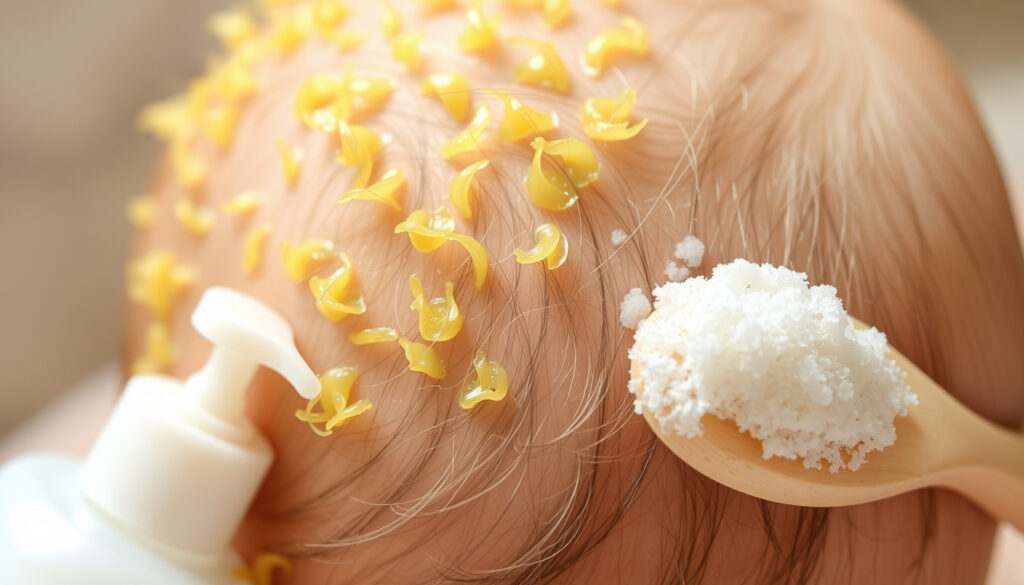
What Is Cradle Cap? Causes, Symptoms & Baby Treatment
If you’ve spotted greasy, yellowish patches on your baby’s scalp, you’re looking at one of the most common infant conditions there is. Cradle cap shows up in the first few weeks of life and can look more alarming than it actually is. The good news: it’s harmless, manageable at home, and almost always clears before your baby’s first birthday.
Affects: newborns and infants · Main symptom: greasy yellow scales on scalp · Harmless: yes, self-resolves · Common locations: scalp, face, nappy area · Duration: starts before 3 months, clears by 1 year
Quick snapshot
- Harmless and common — affects roughly 10% of newborns (Tiny Health)
- Gentle removal is safe when done correctly
- Clears without treatment before age 1
- Peaks around 3 months of age (Tiny Health)
- Exact cause remains debated
- Malassezia appears in both affected and unaffected infants
- Genetic predisposition not well studied
- Adult recurrence triggers not fully mapped
- Starts: birth to 3 months
- Peaks: around 3 months
- Clears: by 6-12 months
- Recurrence possible throughout first year
- Most cases resolve on their own
- Home care manages symptoms effectively
- See a doctor if no improvement after 2 weeks
- Severe cases may need medicated shampoo
These clinical markers help differentiate cradle cap from more serious scalp conditions.
| Label | Value |
|---|---|
| Definition | Scaly skin on baby scalp |
| Onset age | Birth to 3 months |
| Contagious | No |
| Self-resolves | By 6-12 months |
| See doctor if | Bleeding, pus, fever |
What is the main cause of cradle cap?
The exact cause of cradle cap is not fully understood, but multiple factors likely contribute (Mayo Clinic). What doctors have confirmed is that maternal hormones passed to the baby before birth stimulate the oil glands and hair follicles to produce excess sebum, the oily substance that coats the scalp (Mayo Clinic). That excess sebum then causes skin cells to stick to the scalp instead of shedding naturally (Tiny Health).
A fungus called Malassezia, which grows in sebum, may also play a role in cradle cap development (Mayo Clinic). This fungus is found on approximately 13-50% of newborns’ skin within their first week, likely acquired from maternal skin (Tiny Health). Malassezia’s role remains unclear because it is also found in infants without the condition (Tiny Health).
Risk factors in newborns
Hormonal activity from pregnancy is the primary suspected trigger. Maternal hormones transferred before birth cause sebaceous glands to become overactive (Mayo Clinic). Disruption of the skin microbiome can also lead to overgrowth of Malassezia and Staphylococcus aureus, which may contribute to symptoms (Tiny Health).
Link to seborrheic dermatitis
Cradle cap is considered a form of infant seborrheic dermatitis, the same condition that causes dandruff in adults. The key difference lies in the triggers: in newborns, maternal hormones are the driving force, whereas in adults, stress and immune factors typically play a larger role.
Cradle cap is not caused by poor hygiene, allergies, or bacterial infection (Pampers).
Should I remove my baby’s cradle cap?
Most of the time, cradle cap doesn’t bother your baby. It’s usually not itchy or painful (Cleveland Clinic). The NHS describes it as patches of greasy, scaly skin on the scalp that typically don’t cause discomfort.
That said, there are good reasons to avoid picking at the scales: it can break the skin and lead to infection (Cleveland Clinic). Mayo Clinic recommends gentle removal rather than aggressive picking.
When to leave it alone
If the patches are thin, limited to the scalp, and your baby seems unbothered, regular gentle washing may be all you need. Cleveland Clinic notes that cradle cap is not a serious condition and will resolve on its own.
Gentle removal methods
When you do want to help the scales along, Cleveland Clinic recommends applying mineral oil, petroleum jelly, or baby oil to the scalp before shampooing to soften and loosen the scales. MedlinePlus adds that applying mineral oil and wrapping warm, wet cloths around the head for up to one hour before shampooing can loosen stubborn scales, though caregivers must monitor that warm, wet cloths do not become cold as this can reduce the baby’s body temperature.
After shampooing, gently brush the baby’s hair with a soft brush to help remove loosened scales (MedlinePlus). Brushes should be washed daily with soap and water to remove scales and scalp oil (MedlinePlus).
Avoiding olive oil and peanut oil is important — Cleveland Clinic warns that these can cause skin concerns and allergy risks in infants.
Aggressive removal attempts risk breaking the skin and inviting infection, so patience with gentle methods pays off.
How do you prevent cradle cap?
Cradle cap is not fully preventable. Mayo Clinic notes that shampooing baby’s hair every few days or daily can help keep the scalp clean and may reduce severity, but it won’t guarantee prevention.
Daily hygiene routines
Regular gentle washing is the most consistent step you can take. Use a mild baby shampoo and softly massage the scalp during bath time. Raising Children Network recommends daily gentle washing as part of routine infant care.
Diet and maternal factors
Breastfeeding may support a balanced baby microbiome, which could theoretically help prevent cradle cap (Tiny Health). While the evidence here is moderate, breastfeeding offers well-documented benefits regardless.
Stress and sleep deprivation may act as triggers for cradle cap flare-ups, according to Healthline. The National Sleep Foundation recommends newborns get at least 14-17 hours of sleep per day, and infants need 12-15 hours.
Even with consistent care, cradle cap may recur during the baby’s first year (St. Louis Children’s Hospital).
How to stop cradle cap in newborns?
For mild cases, regular washing and gentle brushing are often sufficient. Tiny Health notes that baking soda mixed with equal parts water can be applied briefly and rinsed during bath time to loosen scales, though this has medium confidence evidence.
Step-by-step home treatment
- Apply a small amount of mineral oil, petroleum jelly, or baby oil to the scalp (Cleveland Clinic)
- Massage gently and leave for several hours or overnight (Cleveland Clinic)
- Wrap a warm, wet cloth loosely around the head for up to one hour (MedlinePlus)
- Wash with a mild baby shampoo, focusing on the scaled areas
- Gently brush with a soft baby brush to loosen scales (MedlinePlus)
- Wash the brush daily with soap and water (MedlinePlus)
When to use medicated shampoos
If home care doesn’t improve the condition after 2 weeks, Raising Children Network recommends consulting a doctor. For severe cases, doctors may recommend a short-term course of low-potency hydrocortisone cream or 2% ketoconazole shampoo (Tiny Health). For more detailed information on treating cradle cap, consult our Mini Bounce Ipswich safety guide.
Antifungal treatments like ketoconazole often help control cradle cap symptoms (Mayo Clinic). If inflammation or infection is present, doctors may also prescribe antibiotics or mild steroid-based cream (Medical News Today).
What is the quickest way to get rid of cradle cap?
An overnight oil soak followed by gentle combing is one of the faster home methods. Apply mineral oil, cover with a soft cap or cloth, and shampoo the next morning before brushing out the softened scales (Cleveland Clinic).
Fast-acting remedies
- Overnight mineral oil application + gentle combing
- Warm wet cloth wrap for up to one hour before shampooing (MedlinePlus)
- Regular brushing several times daily to prevent scale buildup (MedlinePlus)
Professional treatments
For stubborn cases, doctors may prescribe 2% ketoconazole shampoo (Tiny Health). Low-potency hydrocortisone cream used short-term can reduce inflammation in severe cases (Tiny Health).
With consistent care, cradle cap typically clears in days to weeks depending on severity. Cleveland Clinic notes that it generally goes away before the baby’s first birthday.
Upsides
- Harmless and self-resolving
- Home treatment is usually effective
- No lasting effects on hair growth
- Clears before age 1 in most cases
Downsides
- Can look alarming to new parents
- May recur during first year
- Picking risks infection
- Severe cases need medical attention
NHS (UK National Health Service)
Patches of greasy, scaly skin on scalp
Mayo Clinic (Academic Medical Center)
Thick yellow crusty patches
Cleveland Clinic (Academic Medical Center)
Goes away before first birthday
For most parents, the approach is straightforward: gentle washing, oil treatment as needed, and patience. Cradle cap resolves on its own timeline, and aggressive intervention is rarely necessary. If the scales are thick, persistent, or showing signs of infection — bleeding, oozing, or spreading — a pediatric visit takes about 10 minutes and can rule out anything more serious.
Related reading: Pain Under Right Rib Cage · Salmon Oil for Dogs
mayoclinic.org, tinyhealth.com, my.clevelandclinic.org, medlineplus.gov, pampers.com, eczema.org, johnsonsbaby.com, youtube.com, healthline.com, stlouischildrens.org, medicalnewstoday.com
Frequently asked questions
Does breastmilk help cradle cap?
Breastfeeding supports a balanced baby microbiome, which may help prevent cradle cap according to some sources (Tiny Health). While the evidence is moderate, breastfeeding offers broad benefits for infant health regardless.
Is cradle cap a hygiene issue?
No. Cradle cap is not caused by poor hygiene, allergies, or bacterial infection (Pampers). It’s a response to hormonal changes and skin microbiome factors, not a reflection of how often you wash your baby.
What is cradle cap in adults?
Adults can experience seborrheic dermatitis, which shares similarities with cradle cap but has different triggers. In adults, stress and immune system factors typically play a larger role. Cradle cap is specific to infants.
Do all babies get cradle cap?
Not all babies get cradle cap. Estimates suggest roughly 10% of babies under one month are affected, with peaks around 3 months (Tiny Health). Many babies never develop it at all.
What are early signs of cradle cap?
Early signs include subtle scalp flaking, mild redness, and small patches of oily, yellowish scales. These can progress to thicker crusting over the first few weeks of life.
Can cradle cap be infected?
Rarely, but yes. Signs of infection include fever, inflamed or weeping skin, bleeding, leaking fluid, and swelling of affected areas (NHS). These symptoms warrant prompt medical evaluation.
Is cradle cap caused by allergies?
No. Cradle cap is not caused by allergies, poor hygiene, or bacterial infection (Pampers). It’s linked to hormonal factors and skin microbiome activity, not food or environmental allergies.
More related posts
 How to Get Rid of Belly Fat: Science-Backed Tips
 When Is the Next World Cup? 2026 Dates, Hosts & Schedule
 IAG Share Price LSE: Forecast & Dividend Analysis (2025)
 Luton Town vs Leeds United: 1-1 Draw, Stats & Analysis
 London Underground Power Outage: Cau e and Affected Line
 Cardiff City vs Newport County: Stats, Prediction & History
 Helen George: Secret ADHD Diagnosis, Split, Baby, Wig
 Fredrikstad vs Crystal Palace – Preview, Predictions, Lineups