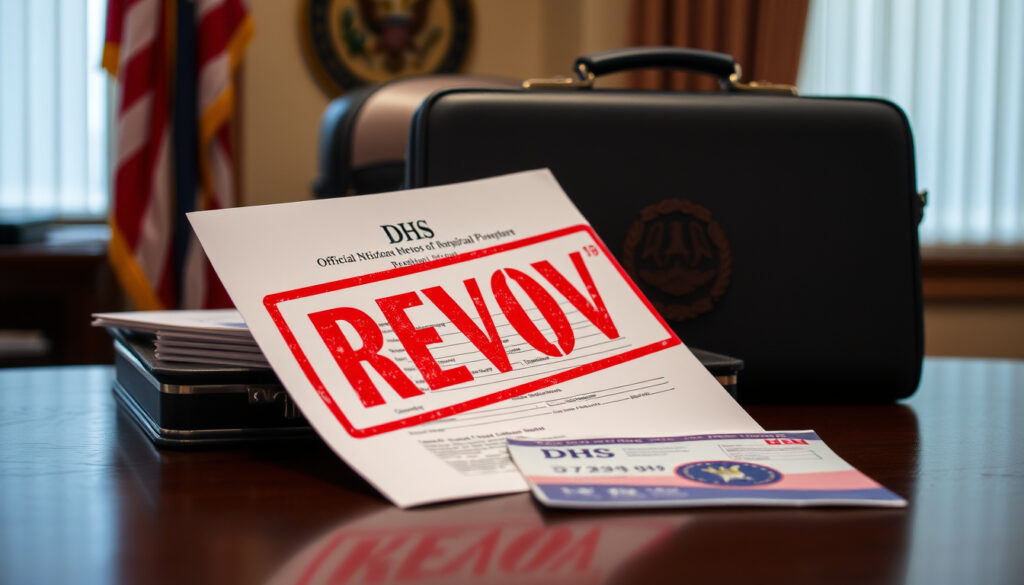
DHS Revokes Humanitarian Parole: CHNV Program Terminated
When hundreds of thousands of people who entered the U.S. under a humanitarian parole program received termination notices in June 2025, many were left scrambling for answers. The Department of Homeland Security’s revocation of parole for Cubans, Haitians, Nicaraguans, and Venezuelans marks a dramatic policy shift affecting over half a million noncitizens.
Parolees affected: 500,000+ · Programs terminated: CHNV and Family Reunification · Date of termination notices: June 12, 2025 · Supreme Court ruling: May 30, 2025 · Parole fee imposed: $1,000 for certain entries
Quick snapshot
- DHS terminated CHNV and Family Reunification parole programs (Federal Register)
- Supreme Court allowed DHS to proceed with termination on May 30, 2025 (LeadingAge)
- Termination notices sent starting June 12, 2025 (AILA)
- Exact number of parolees who will self-deport vs. remain in the U.S.
- Ongoing legal challenges to the termination
- Impact on pending humanitarian parole applications
- March 25, 2025: DHS published Federal Register notice terminating CHNV parole (Federal Register)
- May 30, 2025: Supreme Court emergency stay allowed termination (LeadingAge)
- June 12, 2025: DHS began sending termination notices (AILA)
- December 12, 2025: USCIS terminated Family Reunification parole (Federal Register)
- Parolees must check termination notice deadline and consult an attorney (CLINIC)
- Apply for asylum if eligible (CLINIC)
- Self-deport using CBP Home app or face removal proceedings (Mayer Brown)
Six key facts capture the scope of this policy reversal, from the legal trigger to the human scale.
| Fact | Value |
|---|---|
| Date of termination | June 12, 2025 |
| Affected groups | Cuba, Haiti, Nicaragua, Venezuela |
| Number impacted | Over 500,000 |
| Supreme Court decision | May 30, 2025 |
| Parole fee | $1,000 for certain parolees |
| Programs terminated | CHNV parole, Family Reunification parole |
What happened to the humanitarian parole program?
Why did DHS revoke the program?
On March 25, 2025, DHS published a notice in the Federal Register terminating the parole processes for nationals of Cuba, Haiti, Nicaragua, and Venezuela (CHNV). The department argued the programs were “unnecessary to achieve border security goals” and inconsistent with the administration’s foreign policy objectives, according to the Immigration Policy Tracking Project.
What is the CHNV parole program?
CHNV parole was a Biden-era humanitarian program that allowed up to 30,000 people per month from those four countries to enter the U.S. temporarily for urgent humanitarian reasons or significant public benefit. It granted parole for up to two years and work authorization, per CLINIC.
How many people are affected?
Approximately 530,000 noncitizens who entered under CHNV parole received termination notices, according to Littler. The termination also affects Family Reunification parole beneficiaries.
Half a million people lost lawful status and work authorization overnight. That’s more than the population of Wyoming.
The implication: the administration’s goal of maximizing expedited removal proceedings now faces a logistical test as DHS decides who to detain, who to allow to self-deport, and who will fight the termination in court.
How long can you stay in the US with humanitarian parole?
Standard parole period
Humanitarian parole is typically granted for up to two years, though DHS sets the duration on a case-by-case basis, as explained by CLINIC. The CHNV program originally gave parole for two years with employment authorization.
Can parole be extended?
Extensions are possible but not guaranteed. With the program terminated, existing parole was revoked immediately upon notice delivery on June 12, 2025, per AILA. No further extensions are being granted under the terminated programs.
The catch: even if parole was originally granted for two years, the termination notice invalidates it at once. Parolees have no grace period beyond the deadline stated in their notice.
What happens when humanitarian parole ends?
What are the options after parole ends?
DHS explicitly encourages parolees to self-deport using the CBP Home mobile app and offers travel assistance plus a $1,000 “exit bonus,” as reported by LeadingAge. Those who choose to stay without a legal basis risk being placed in removal proceedings.
Self-deportation and removal proceedings
The termination notice states that parolees without a lawful basis to remain must depart before the deadline, according to the Immigration Policy Tracking Project. DHS earlier indicated that terminating parole without further notice would maximize the number of parolees it could place into expedited removal proceedings.
Employers must check their E-Verify accounts for Status Change Reports on employees whose EADs were revoked, as advised by Littler. Parolees who lose work authorization without another basis to work face immediate income loss.
The trade-off: self-deportation offers a cash incentive but means leaving the country; staying invites removal proceedings and a possible bar on future entry. Neither path is easy.
What is humanitarian parole in removal proceedings?
What is humanitarian parole?
Humanitarian parole is a temporary, discretionary status granted by DHS for urgent humanitarian reasons or significant public benefit. It is not a visa, green card, or any form of permanent residence, as clarified by CLINIC.
Difference from other immigration statuses
Unlike asylum or refugee status, parole does not lead to a path to citizenship. Parolees are not considered “admitted” and have limited rights, including no access to most public benefits. The distinction becomes critical when parole ends: parolees have no automatic right to remain or work.
What this means: parole is a bridge, not a destination. When the bridge collapses, as it did in June 2025, the only way forward is to find another legal status or depart.
Can humanitarian parole lead to asylum?
Can parolees apply for asylum?
Yes, being on parole does not bar a person from applying for asylum. Parolees who fear persecution in their home country can file a separate asylum application, provided they meet the one-year filing deadline and other requirements, as explained by CLINIC.
What happens after an asylum grant?
Asylum is a separate process from parole. If granted, it offers protection from removal, work authorization, and a path to permanent residence and citizenship. However, the parole termination itself does not trigger asylum eligibility—each case must be evaluated on its own merit.
The pattern: parole and asylum serve different legal functions. Parole gives temporary entry; asylum gives protection. The end of parole does not eliminate asylum options, but it removes the legal status that made it easier to work and live while the asylum case is pending.
Upsides and downsides of the termination
Upsides
- DHS argues termination restores border security and aligns with foreign policy goals (Immigration Policy Tracking Project)
- Removes a program that some critics said encouraged irregular migration
- Offers a $1,000 incentive and travel assistance for voluntary departure (LeadingAge)
Downsides
- Over 500,000 people lose lawful status and work authorization immediately (Littler)
- Family reunification parole beneficiaries are also affected, separating families
- Parolees who stay face expedited removal proceedings and possible entry bars
The pattern: DHS frames the termination as a security measure, while advocates point to the massive human cost. Neither side disputes the scale of the impact.
Steps to take after receiving a termination notice
- Check your termination notice. DHS sent notices via email and myUSCIS accounts. Note the deadline to depart. (AILA)
- Consult an immigration attorney. Evaluate eligibility for asylum, TPS, U visa, or other relief. (CLINIC)
- Apply for asylum if you fear persecution. File within one year of last arrival if possible. Parole status is not required to apply.
- Check your E-Verify status. Employers may see a Status Change Report. Contact your employer to discuss options. (Littler)
- Plan for departure if no legal basis exists. Use the CBP Home app to self-deport and claim the $1,000 exit bonus. (Mayer Brown)
- Gather documentation. Keep copies of parole notices, termination letters, and any asylum or visa applications for future immigration proceedings.
The takeaway: time is short. Without a solid legal alternative, self-deportation may be the only way to avoid a removal order and a future entry bar.
Timeline signal
- March 25, 2025: DHS publishes termination of CHNV parole processes in the Federal Register.
- April – May 2025: District court temporarily pauses implementation; DHS delays termination (CLINIC).
- May 30, 2025: Supreme Court issues emergency stay, allows DHS to proceed (LeadingAge).
- June 12, 2025: DHS begins sending termination notices to CHNV parolees (AILA).
- December 12, 2025: USCIS announces end of Family Reunification parole, calling it an “abuse” of humanitarian parole.
The implication: DHS acted aggressively once the legal block was removed, leaving no cushion for parolees to adjust their status or find alternative legal paths.
Confirmed facts vs. what remains unclear
Confirmed facts
- DHS sent termination notices for CHNV parole on June 12, 2025 (AILA)
- Supreme Court ruling on May 30, 2025 allowed termination (LeadingAge)
- Family Reunification parole terminated in December 2025
- Self-deportation option with travel assistance and $1,000 bonus (LeadingAge)
What remains unclear
- Exact number of parolees who will self-deport vs. remain in the U.S. and fight removal
- Ongoing legal challenges to the termination and their potential to reverse or delay it
- Impact on pending humanitarian parole applications that were not yet adjudicated
- How DHS will handle parolees with pending asylum applications or other relief
The pattern: the factual ground is solid, but the future remains uncertain. The coming months will reveal how many parolees choose departure over court battles.
Voices on the termination
“Parolees without lawful status are encouraged to self-deport using the CBP Home app. DHS offers travel assistance and a $1,000 incentive.”
— DHS press release (June 12, 2025), as reported by Mayer Brown
“We are ending abuse of humanitarian parole. The family reunification parole program is terminated effective immediately.”
— USCIS alert (December 12, 2025)
“The Supreme Court’s emergency order allows DHS to proceed with termination of parole for half a million noncitizens. The legal fight is not over, but the immediate effect is devastating for families.”
— SCOTUSblog analysis via LeadingAge
“The termination of Family Reunification parole processes ends a vital pathway that kept families together while awaiting green card processing.”
— Refugees International, cited by CLINIC
The conflicting positions—DHS calling it “ending abuse” and advocates calling it “devastating”—underscore the deep divide over what humanitarian parole was meant to achieve.
What it all means
The revocation of humanitarian parole for CHNV and Family Reunification programs is more than a procedural change. It is a deliberate policy shift that forces hundreds of thousands of people into impossible choices: leave behind jobs, homes, and community ties, or risk removal and a potential bar on re-entry. For the 530,000 CHNV parolees, the decision is clear: find a legal pathway to stay—through asylum or other relief—or prepare to exit the country before DHS enforcement actions begin.
For those affected, a closer look at the CHNV parole termination details reveals the scope of the policy shift.
Frequently asked questions
What should I do if I receive a termination notice?
Check the deadline in the notice, consult an immigration attorney immediately, and evaluate eligibility for asylum, TPS, or other relief. If no legal basis exists, consider self-deportation via the CBP Home app to avoid removal proceedings.
Is there a fee to apply for humanitarian parole?
Yes, USCIS charges a filing fee for humanitarian parole applications. For certain parolees, a $1,000 parole fee has been imposed under the new policies, as reported by LeadingAge.
What is the $1,000 parole fee?
It is a fee imposed on certain parole applications or as an exit incentive. In the context of CHNV termination, DHS offers a $1,000 exit bonus for self-deportation, not a fee.
Can parolees adjust status to a green card?
Parole itself does not provide a direct path to a green card. Parolees may adjust status if they have a separate eligible petition (e.g., family sponsorship, employment) or if they qualify for asylum.
How does the family reunification parole program differ from CHNV?
Family Reunification parole allowed certain family members of U.S. citizens or lawful permanent residents to enter while waiting for visa availability. CHNV was a broader humanitarian program for nationals of four countries. Both were terminated in 2025.
What was the Biden administration’s parole policy?
The Biden administration created the CHNV parole program to provide legal pathways for up to 30,000 people per month from Cuba, Haiti, Nicaragua, and Venezuela. It also expanded family reunification parole. These programs were ended by the Trump administration in 2025.
What is the deadline for CHNV parolees to leave the US?
The termination notice sent on June 12, 2025 specifies a deadline. Parolees should check their individual notice. DHS has not announced a blanket date; deadlines vary depending on when the individual received notice.
More related posts
 Taxi Service Near Me: Uber vs Local Taxis in Ireland
 Line of Duty Series 3 – Plot, Cast and Ending Explained
 1 Pound in Grams – Conversions for Cooking & Baking
 Strictly Come Dancing Results – Week 5 Scores and Leaderboard
 Portugal vs Spain Stats: Head-to-Head & Nations League 2025
 Imane Khelif: Gender Eligibility Controversy Explained
 How Many Miles Is a Half Marathon – Exact Distance Explained
 Mental Health: Definition, Types, Signs, and Ways to Improve