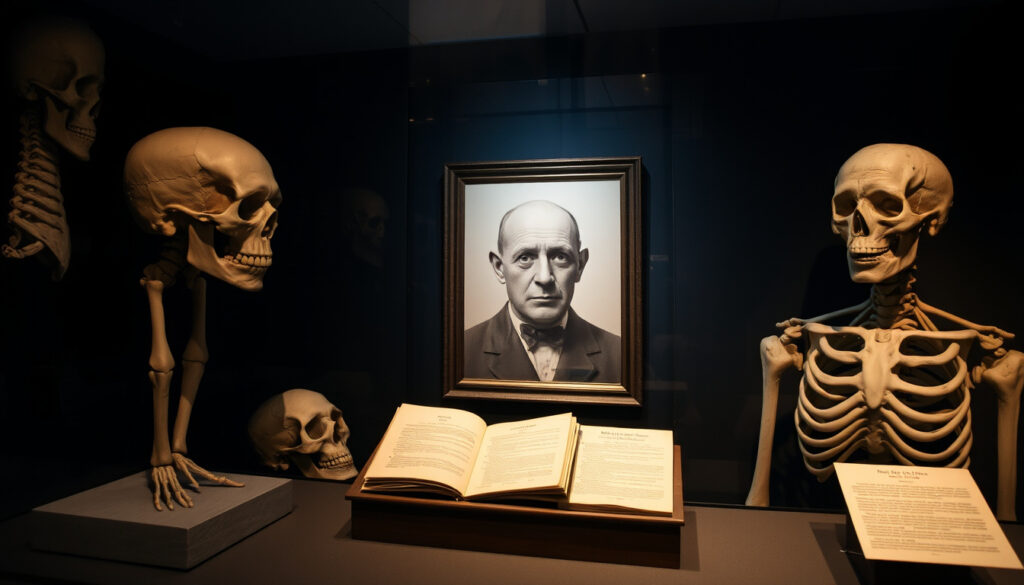
Elephant Man: True Story, Syndrome, and Medical Facts
Few biographical stories have been as blurred by Hollywood as the tale of Joseph Merrick, the man history remembers as the Elephant Man. The 1980 film by David Lynch turned his life into a haunting drama, but the real Merrick lived a quieter, more complex story—one that continues to raise questions about medicine, ethics, and human dignity. Born on 5 August 1862 in Leicester, England, Merrick spent his final years at the London Hospital, where he was cared for by surgeon Frederick Treves (London Museum (historical archive)).
Real name: Joseph Merrick ·
Born: 1862 ·
Died: 1890 ·
Condition: Proteus syndrome (likely) ·
Film release: 1980 ·
Film director: David Lynch
Quick snapshot
- Born in Leicester, England in 1862 (London Museum)
- Developed severe deformities in early childhood (Genome.gov)
- Exhibited in sideshows, later lived at London Hospital (Genome.gov)
- Died in 1890 at age 27 (Genome.gov)
- Now known as Proteus syndrome (Encyclopaedia Britannica)
- Causes asymmetric overgrowth of tissues (NCBI PMC)
- Rare, with fewer than 200 documented cases (Genome.gov)
- Not contagious or hereditary in most cases (Wikipedia)
- Directed by David Lynch (Wikipedia)
- Starred John Hurt and Anthony Hopkins (Wikipedia)
- Nominated for eight Academy Awards (Wikipedia)
- Loosely based on Merrick’s life (London Museum)
Six key facts, one takeaway: the gap between the historical record and the popular image is wider than many assume.
| Label | Value |
|---|---|
| Full name | Joseph Carey Merrick |
| Birth date | 5 August 1862 |
| Death date | 11 April 1890 |
| Condition | Proteus syndrome (likely) |
| Film release | 1980 |
| Film director | David Lynch |
Was the Elephant Man a true story?
The real Joseph Merrick
- Joseph Carey Merrick was born in Leicester, England on 5 August 1862 (London Museum (historical archive)).
- He developed visible deformities from early childhood, though he was born without them (About London Laura (biographical site)).
- By the 1880s he was exhibited in Whitechapel under the name “Half-a-Man and Half-an-Elephant” (London Museum (historical archive)).
- Dr. Frederick Treves encountered him at a sideshow in 1884 and later arranged for his admission to the London Hospital (Genome.gov (National Institutes of Health)).
- Merrick lived there for the remainder of his life and died on 11 April 1890 at age 27 (Genome.gov (National Institutes of Health)).
How the film deviates from history
- The 1980 film The Elephant Man dramatises Merrick’s story, adding fictional scenes and composite characters (Wikipedia).
- In the film, Merrick is forcibly separated from his mother and abused by a cruel showman; in reality, his mother died when he was young and his exhibit was managed by a series of showmen, some of whom treated him fairly (London Museum).
- The film’s climactic courtroom scene is entirely invented (Wikipedia).
- Merrick’s own writings show he was articulate and grateful for his care, not the victimised figure of the film’s most emotional moments (About London Laura).
The film made Merrick a household name, but it also cemented a fictional victim narrative that overshadows the real man’s resilience and self-awareness.
What this means: the Elephant Man is a true story, but not the one the film tells. The real Merrick was not a passive sufferer but a man who used his earnings from exhibitions to support himself and later expressed happiness in his hospital home.
What is The Elephant Man syndrome?
Proteus syndrome explained
- For decades, Merrick’s condition was misdiagnosed as neurofibromatosis type I (Encyclopaedia Britannica).
- In 1986, a British Medical Journal paper by Michael Cohen and J. A. R. Tibbles proposed that Merrick actually suffered from Proteus syndrome, a rare overgrowth disorder (Wikipedia).
- Proteus syndrome is caused by a somatic mutation in the AKT1 gene and is not inherited (NCBI PMC (medical literature)).
- DNA testing on Merrick’s hair and bone in 2003 supported the diagnosis, though some researchers suggest he may also have had a mild form of neurofibromatosis (About London Laura).
Symptoms and characteristics
- Proteus syndrome involves asymmetric overgrowth of bones, skin, and other tissues (PMC (medical study)).
- Merrick’s deformities included macrocephaly, hyperostosis of the skull, hypertrophy of long bones, and thickened skin (PMC).
- The condition is described as somatic mosaicism, meaning the mutation affects only some cells (NCBI PMC).
- It is not contagious and does not arise from any environmental exposure (Genome.gov).
Historical misdiagnosis
- The earlier neurofibromatosis hypothesis was based on superficial similarities, but Merrick lacked the café au lait spots characteristic of that condition (Wikipedia).
- A 2015 PubMed-indexed review concluded that Proteus syndrome is the most likely diagnosis (PubMed (peer-reviewed review)).
- Britannica now identifies Proteus syndrome as the probable cause (Encyclopaedia Britannica).
The shift from neurofibromatosis to Proteus syndrome changed how doctors understand rare overgrowth disorders—and gave Merrick a posthumous diagnosis that fits his documented symptoms.
The pattern: medical understanding of Merrick’s condition evolved slowly, but modern genetics has finally provided a label that explains his physical reality.
Could John Merrick be cured today?
Modern treatment options
- There is still no cure for Proteus syndrome (PubMed).
- Treatment focuses on managing symptoms: surgical removal of overgrowths, physical therapy, and monitoring for complications such as thrombosis (Genome.gov).
- Drugs targeting the AKT pathway are being researched but are not yet standard therapy (NCBI PMC).
Limitations of current medicine
- Because the condition is mosaic, treatments must be tailored to each patient’s specific growth patterns (NCBI PMC).
- Even with modern surgery, some overgrowths recur (PubMed (2005 paper)).
- Merrick’s deformities would have been far more manageable with today’s imaging and surgical techniques, but his underlying condition would still be incurable (Genome.gov).
Ethical considerations
- Merrick’s case raises questions about the ethics of exhibiting people with visible differences—a practice that continues in different forms today (London Museum).
- His story also highlights the importance of dignity and care for patients with rare, disfiguring conditions (London Museum).
Modern medicine could have given Merrick a better quality of life, but the fundamental question—how society treats those who look different—remains unanswered.
The implication: the cure for the Elephant Man syndrome is not just medical. It’s a societal one that asks us to separate the person from the condition.
What was the famous line from The Elephant Man?
The iconic quote
- In the 1980 film, Merrick (played by John Hurt) shouts: “I am not an elephant! I am not an animal! I am a human being!” (Wikipedia).
- The line was written by screenwriters Christopher De Vore and Eric Bergren (Wikipedia).
Context in the film
- The outburst occurs when Merrick is being chased by a mob that sees him as a monster (Wikipedia).
- It became the film’s most memorable moment and a rallying cry for human dignity (Wikipedia).
Real Merrick’s own words
- In a letter to Dr. Treves, the real Merrick wrote: “I am happy every hour of the day” (About London Laura).
- He also expressed gratitude for the care he received, showing a self-awareness that contradicts the film’s portrayal of him as a helpless victim (About London Laura).
The catch: the famous line is a powerful piece of fiction, but the real Merrick’s own words reveal a quieter, more contented voice.
How rare is elephant man disease?
Prevalence of Proteus syndrome
- Proteus syndrome affects fewer than 1 in 1 million people (Genome.gov (National Institutes of Health)).
- Only a few hundred cases have been documented worldwide (Genome.gov).
Why it is often misdiagnosed
- Because of its rarity, Proteus syndrome is frequently mistaken for other overgrowth syndromes such as neurofibromatosis or Klippel-Trénaunay syndrome (PubMed).
- Many cases are diagnosed only after genetic testing (NCBI PMC).
For a condition this rare, Merrick’s prominence has ironically made him the most famous face of a disease that most people will never encounter.
Why this matters: the rarity of Proteus syndrome means that each case contributes significantly to medical knowledge, and Merrick’s case continues to be studied.
Timeline
The timeline below marks the key events in Merrick’s life and legacy.
| Date | Event |
|---|---|
| 1862 | Joseph Merrick born in Leicester, England (London Museum) |
| 1884 | Merrick meets Dr. Frederick Treves at a sideshow (Genome.gov) |
| 1886 | Merrick moves to London Hospital under Treves’ care (Genome.gov) |
| 1890 | Merrick dies at age 27 from asphyxiation (Genome.gov) |
| 1980 | The Elephant Man film released, directed by David Lynch (Wikipedia) |
What is confirmed and what remains unclear
Confirmed facts
- Merrick had a severe deforming condition now identified as Proteus syndrome (PubMed)
- His deformities were not contagious (Genome.gov)
- He was intelligent, articulate, and self-taught (London Museum)
- He spent his final years at London Hospital (Genome.gov)
What’s unclear
- Exact cause of death (possibly positional asphyxia) (Genome.gov)
- Whether he had additional underlying conditions (About London Laura)
- Some details of his early life and family history (About London Laura)
- Whether Merrick also had a mild form of neurofibromatosis type I (About London Laura)
Quotes
“I am not an elephant! I am not an animal! I am a human being!”
— Joseph Merrick (as portrayed by John Hurt in The Elephant Man, 1980) (Wikipedia)
“I am happy every hour of the day.”
— Real Joseph Merrick, in a letter to Dr. Frederick Treves (About London Laura)
Two voices, one man: the fictional Merrick shouts for recognition; the real Merrick quietly found peace in a small room at the London Hospital.
Summary
For anyone trying to understand the Elephant Man story, the separation between history and Hollywood is not just a matter of accuracy—it’s a reminder that a human being lived behind the label. The real Joseph Merrick was not a sideshow freak or a film character, but a person who found dignity in the care of others. For readers who want to know more about the medical side of rare conditions, resources like Mental Health: Definition, Types, Signs, and Ways to Improve and What Is Dangerously Low Ferritin? Symptoms and Thresholds offer related health information. The choice is clear: remember the man, not the myth.
cbsnews.com, pubmed.ncbi.nlm.nih.gov, history.howstuffworks.com, simple.wikipedia.org
For a deeper look at the medical and historical details, the true story of Joseph Merrick offers a comprehensive overview of his life and condition.
Frequently asked questions
Did Joseph Merrick have a normal childhood?
He was born without deformities, but visible growths appeared in early childhood. By age 17 he lived with a severe curvature of the spine and had to seek work at a workhouse (London Museum).
What was the real Elephant Man’s condition?
It is now believed to be Proteus syndrome, a rare overgrowth disorder caused by a mutation in the AKT1 gene (PubMed).
Who was Dr. Frederick Treves?
He was a surgeon at the London Hospital who rescued Merrick from sideshow life and arranged for his permanent residence at the hospital (London Museum).
How accurate is the 1980 film?
It is loosely based on Merrick’s life but adds fictional characters, a courtroom scene, and a more dramatic victim narrative. Merrick’s own letters show a much happier outlook (About London Laura).
Why was he called the Elephant Man?
His exhibitors marketed him as “Half-a-Man and Half-an-Elephant” because of the size and texture of his growths, which resembled elephant skin (London Museum).
What happened to the Elephant Man’s skeleton?
After his death, Merrick’s skeleton was preserved and is held at the Royal London Hospital Medical College, though it is not on public display (Genome.gov).
Where can I watch The Elephant Man?
The film is available on streaming platforms such as Amazon Prime Video, Apple TV, and the Criterion Channel, as well as on DVD and Blu-ray (Wikipedia).
More related posts
 Fredrikstad vs Crystal Palace – Preview, Predictions, Lineups
 UK Gas Prices Surge – Causes, Impacts and Forecasts
 1 Pound in Grams – Conversions for Cooking & Baking
 Once Upon a Broken Heart: Plot, Spice, Age Rating & Reading Order
 Sonic Boom in Essex Today: What Caused the Loud Bang?
 Liz Marsland: Biography, Age, Career, Net Worth, Family
 Graphic Design Is My Passion – Meme Origins and Industry Critique
 London Things to Do – Top Attractions Free Museums Itineraries